Why We Built Shuush: An Open-Source Local Superwhisper & Wispr Flow Alternative for Linux
TL;DR · Direct Answer & Verified Benchmarks
- What Shuush is: A free, MIT-licensed desktop intelligence layer & native GTK4 Studio built on top of stock
voxtypefor Linux/Wayland (Hyprland, Omarchy, Sway, Niri) with first-partykuwairice integration.- Why not cloud dictation? Wispr Flow costs $15/month and doesn’t ship on Linux; Omarchy’s default Superwhisper cloud tier caps free usage at 10,000 words/month. We already dictated 19,498 words across 333 real takes (~8.1 hours saved).
- Measured performance (Intel i5-13450HX · RTX 4050 Laptop 6 GB VRAM · 23 GiB RAM): Parakeet fp16 uses ~2.3 GB VRAM locally; end-to-end cleanup runs at 516 ms P50 / 1,060 ms P90 with 98.8% reliability (or 24 ms when already clean).
1. The Gap on Linux Voice Dictation
Voice dictation became genuinely useful for software engineers once tools like Wispr Flow and Superwhisper paired speech recognition with active window context and fast LLM cleanup.
On Linux, however, developers hit a frustrating split: accept closed-source apps with monthly word caps (like Superwhisper’s 10,000 free words/30 days on Omarchy), or wire bare Whisper scripts that spell Waybar as “webar”, Next.js as “next year”, and voxtype_pp_gate as “box type pp gate”.
Instead of forking or reinventing the Rust audio/inference daemon, we built Shuush cleanly on top of Peter Jackson’s MIT-licensed voxtype. Proper separation of concerns means:
voxtypeowns low-level PipeWire capture, CUDA/Vulkan/CPU ASR inference (Parakeet, Whisper, Cohere GGUF), and Wayland typing.shuushowns the 5-source context pipeline, anti-paraphrase span gate, phonetic self-learning engine,KitsuneHudQuickshell pill, and native GTK4 Studio.kuwai(or your own Hyprland/Sway/Niri config) only keeps compositor bindings, window rules, and optional island hosting — zero duplicated dictation scripts.
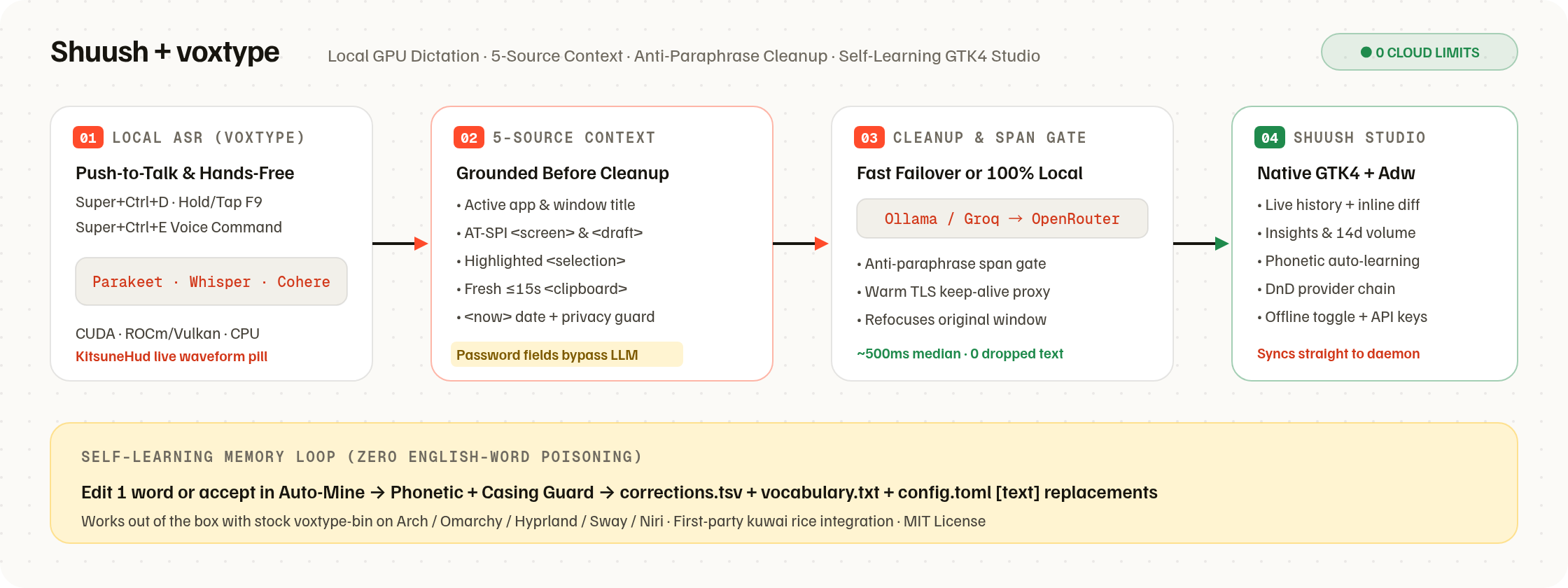
2. Five Grounded Context Sources — Locally and Unlimited
Superwhisper’s signature mode works because the cleanup model sees what you’re looking at. Shuush captures 5 bounded, secret-redacted context sources on Wayland the instant you press your hotkey:
- Active application & window title (Hyprland, Niri, Sway) to pick the right profile (
terminal,chat, ordefault) and refocus the original window if you switch away while polishing. - AT-SPI visible
<screen>& focused<draft>(voxtype_screen_ctx.py, hard-capped at 250ms) so visible identifiers ground symbol spelling — and real password fields trigger an instant privacy bypass. - Highlighted
<selection>captured in the background on normal dictation too, so saying “fix this error in that hook” resolves exact identifiers. - Fresh
<clipboard>(≤15-second window) tracked by SHA-256 hash + timestamp, so a stack trace copied 5 seconds ago improves accuracy while a 2-hour-old clipboard never pollutes a prompt. - Current date anchor (
<now>) so relative date references stay grounded.
3. Why Raw LLM Cleanup Fails — and the Anti-Paraphrase Span Gate
Anyone who pipes raw Whisper output into an LLM hits the same wall: the model rewrites your phrasing, drops flags, or answers dictated questions instead of transcribing them.
Shuush’s deterministic voxtype_pp_gate.py aligns every cleaned reply back against the raw ASR transcript. Word changes are accepted only if they are filler removals, punctuation/casing fixes, or phonetically close to a term grounded in your vocabulary.txt, corrections.tsv, or live 5-source screen context. When text is already clean, Shuush skips the LLM entirely in 24 ms.
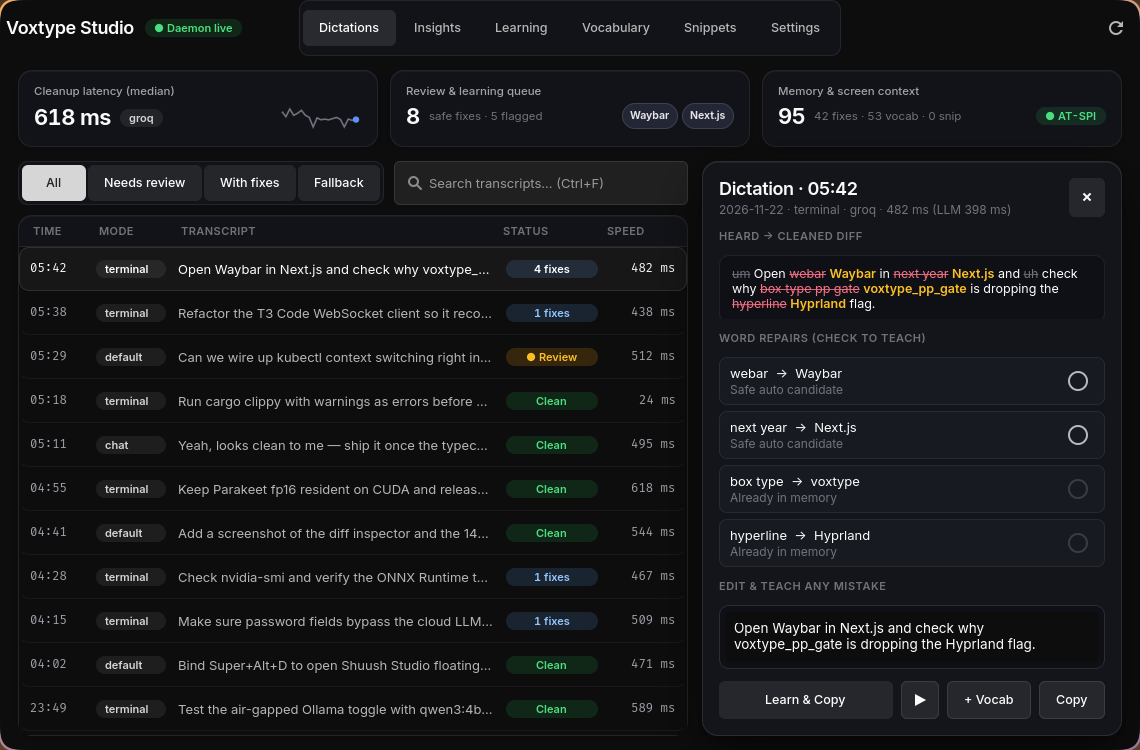
4. Non-Poisoning Phonetic Self-Learning
Naive auto-learning stores catastrophic rules like hosts → hooks or things → tasks the first time an LLM guesses from context. Shuush enforces four strict guards in voxtype_learn.py:
- Cross-distro English blocklist: probes system dictionaries across Arch, Debian, Ubuntu, and Fedora plus a built-in fallback wordlist.
- Phonetic & spoken-digit folding: catches ASR splits like
t three → T3andcube ctl → kubectlautomatically when grounded in your screen or vocabulary. - Casing-preserving swap logging: preserves
Next.js,Waybar, andT3casing in history swaps. - Permanent Dismiss/Reject blocklist with Undo + automatic sync into
voxtype’s Layer-1config.toml [text] replacements.
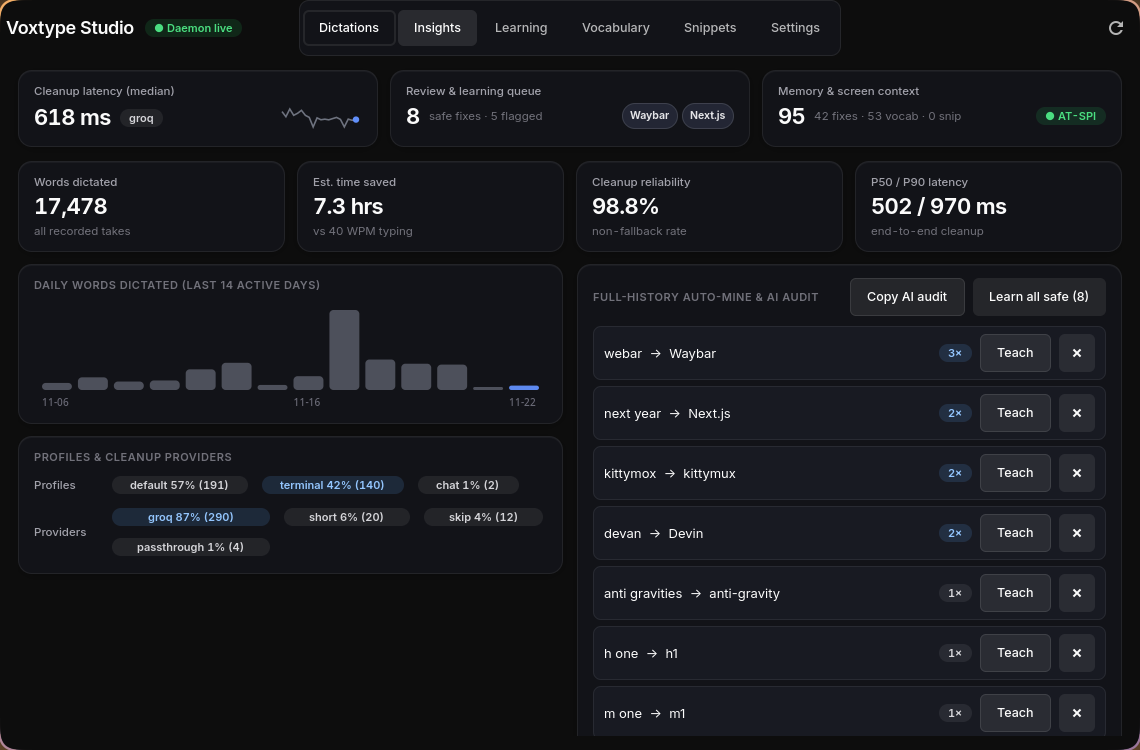
5. Real-World Hardware Benchmarks (333 Takes)
Measured on an Intel i5-13450HX · NVIDIA RTX 4050 Laptop (6 GB VRAM) · 23 GiB RAM · Arch + Hyprland:
| Metric | Measured Value | Notes |
|---|---|---|
| Speech-to-text VRAM | ~2.3 GB | Parakeet Unified EN 0.6B fp16 on CUDA |
| Dictation volume | 19,498 words | 333 takes (~8.1 hours saved vs 40 WPM typing) |
| Cleanup latency | 516 ms P50 · 1,060 ms P90 | Warm TLS keep-alive proxy + Groq failover |
| Clean-pass fast path | 24 ms | Deterministic bypass when already clean |
| Reliability | 98.8% | 1.2% cleanly fall back locally — zero dropped text |
6. Install in 60 Seconds
Works out of the box on stock voxtype-bin across NVIDIA CUDA, AMD ROCm/Vulkan, Intel Vulkan, and CPU:
yay -S voxtype-bin wtype wl-clipboard jq python-gobject libadwaita gtk4 at-spi2-core
voxtype setup
git clone https://github.com/KitsuneKode/shuush.git && cd shuush
./install.sh --wire-config
shuush doctor && shuush studio
Open Settings (Alt+6) to flip Air-gapped offline mode (Ollama only) or enter cloud API keys (chmod 600 in ~/.config/voxtype/secrets.env).